

It Tastes Like Data
Amanda Pearn on Carolyn Bessette Kennedy, purism, and why data-driven design is eroding our sense of taste.


Welcome back to another installment of Cache’s Guest Editor series! Today we are featuring tailor, educator, and fashion lover Amanda Pearn! This series is very important to Cache, it’s a space where we hand the mic over to sharp thinkers and creators who have something real to say about fashion and the world around it.
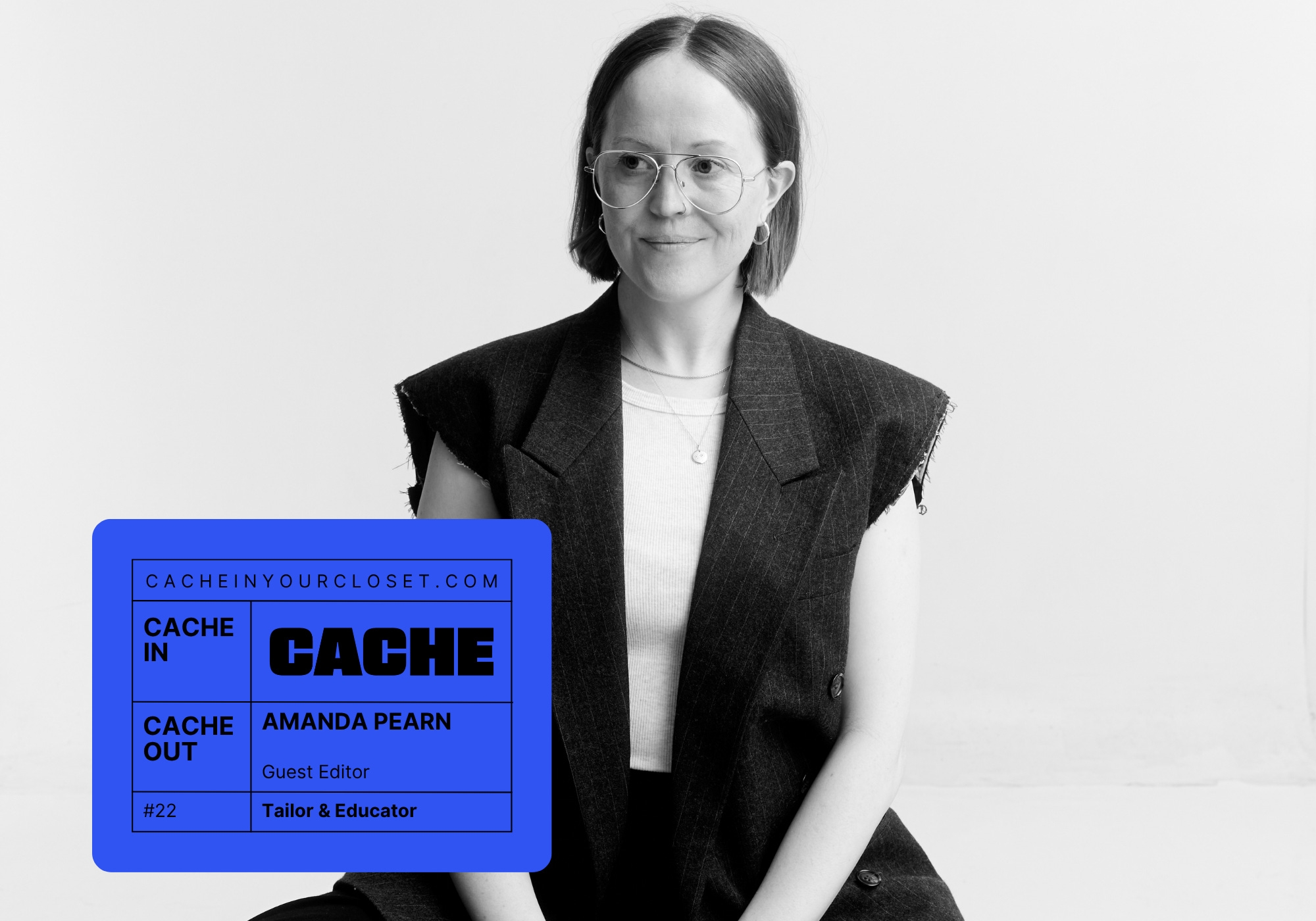
Today, Amanda is zooming out to look at the bigger picture. She's tracing how consumer habits around fashion have evolved since the rise of the digital world, from the slower, more insular pace of print media to the instant, data-driven, algorithm-fed shopping experience we live in now. It's a piece about what we gained with all this access and speed, and more importantly, what we quietly lost along the way.
Here at Cache, we believe style is an ongoing process rooted in psychology. It’s deeply subjective, and it can’t be reduced to simply buying into the latest trends.
It Tastes Like Data
Like everyone else watching Ryan Murphy’s Love Story in March, I was enamored with Carolyn Bessette Kennedy’s style. But what stood out wasn’t the cool-girl aesthetic of working at Calvin Klein, 90s nostalgia, or the never-ending drama, but more specifically, the sartorial choices. The precise moment when Carolyn is getting her nails done at the salon and we (the viewer) notice a single band on her ring finger. What stood out most about this moment was that it would never happen today. Not when each finger could be adorned with rings and her wrist could be stacked with Cartier bracelets to compliment an expensive designer watch.
Today’s television is hyper-focused on shop-ability. More is more and brands are doing everything in their power to make us want it. A simple reddit search will confirm what was worn in an episode of Nobody Wants This or Beef. I know this because my husband will often google things like: What jacket was Tom Hardy wearing in Dunkirk? or What brand of eyeglasses did Ryan Gosling have on in Project Hail Mary? The Internet always delivers.

Online shopping has become a treasure trove of data, a place to determine trends (macro and micro) in style, colour, design, detail, marketing, social, etc. Companies are not only fighting for attention but have also become hyper-fixated on data to inform their next steps. They rely on numbers to decide what styles to add to a collection in the hopes that they might grab the finite attention of a customer. For brands, the heavy reliance on data can begin to erode taste and misguide a brand’s internal design compass; their North Star to maintain authenticity, developed over years of trial and error. Not aggregated data. While it is beneficial to have access to data, it is easy to get lost due to the sheer volume available.
Data collection has solved some problems within the fashion industry, it has curbed [some] over-manufacturing and offered small designers a means for selling made to order batches of clothing instead of having to order multiple size runs at one time. It makes business decisions more efficient and gives a buyer or merchandiser historical context to plan seasons effectively. When used in moderation, data can help make choices more streamlined. However, it should not replace gut instinct built through time, lived experience, and trial and error.
Carolyn Bessette Kennedy’s style didn’t evolve from following trends or an algorithm. It developed through building the intuition for how she wanted to show up in the world. This is why Love Story was aptly timed. It bridged the gap between viewers who lived through the 90s, offering a nostalgic reminder of youthful abandon (pre-cellphone) and a younger generation that romanticizes a time before social media and chronicling daily life through TikTok.
Purism Design Aesthetic
Context is key when reviewing the fashion of any decade. 1987 was marked by the stock market crash. It demolished the wave of opulent times and “greed as good” mentality in favour of simplicity and underscoring the purism movement of the 1990s. This event reflected the consumer sentiment moving into the next decade, where people needed to reassess their spending habits and simplify their lives. No single fashion movement occupied the entire decade. Instead, it was occupied by a series of smaller fashion movements, macro and micro trends which changed every few years to something new. Those movements included countercultural trends like futurism, grunge, purism, and romanticism which spoke to the ethos of the designer.
Calvin Klein leaned on “Purism” to showcase a different point of view based on the elegant slip dresses and lingerie of the 1930s. Not to be confused with minimalism, purism focused on omitting superfluous details in favour of simple, unpretentious styles and strong architectural silhouettes. On Vogue’s The Run-Through Podcast, Nicole Phelps interviewed Calvin Klein where he discussed his desire to design with restraint. Klein aimed to remove all unnecessary spectacle of adornment to rely on silhouette, taking inspiration from tailored garments which he was fascinated with. This was a sentiment shared by a few New York based designers of that time including Donna Karan, Ralph Lauren, and Jil Sander.
“If design is good, shape is good, it doesn’t need extra “stuff”
- Calvin Klein, Vogue Run-Through Podcast
The purism trend, and more importantly, Carolyn Bessette Kennedy had a far-reaching impact on the fashion of the time. Beyond the clothing, it was the embodiment of attitude and style, an indescribable aura attached to her persona, emphasizing her natural intuition for self-expression through her clothes.

Erosion of Design Intuition
Restraint is required to understand Carolyn’s point of view on fashion and style. Additional jewelry, accessories, and other miscellaneous bits and bobs deviate from the original ethos of purist style. While the internet is an excellent way to build community through shared ideas, genuine taste has proven to be more elusive. Writer Matteo Azzolini eloquently penned a Substack article summarizing today’s obsession with Carolyn Bessette Kennedy and why modern taste has evolved in favour of ‘more is more’. Azzolini suggests that taste is a slow, uncomfortable discovery, counterintuitive to today’s fast-paced desire to establish identity. He navigates the social media frenzy of CBK coded hashtags to investigate the collective understanding of how a younger generation interpreted the Love Story aesthetic.

Prior to social media, print media was how taste was formed. Magazines dictated seasonal trends and readers would follow suit. Looking back, the process was more insular and relied on select fashion gatekeepers. With social media, reach has expanded, making space for multiple styles to exist outside of the pre-determined trends set by print media. In contrast, today’s collection development relies on digital consumer insights. With this comes a quicker design process, which requires constant editing. Designers do not want to fail through guesswork, and instead, opt for quick answers and guaranteed success. Design intuition extends beyond the fashion industry landscape and into daily life. The expanse of social media, and ease of online shopping, have given way to faster transactions which in turn erode personal taste.

Consumer Shopping Habits
In the 1990s, online shopping was unfathomable. Shopping was done in person, and the availability of product was restricted to the geographic location where the shopping occurred. Customers would go into a physical store to touch, feel, and try on clothing and ensure accurate fit. The mall was a social gathering place for all ages, people interested in spending time together in a well-ventilated location, eating at the food court, and maybe, just maybe, buying some new clothes (hence why many 90s cult-classics such as Mallrats and Clueless were set in the mall). In previous decades, the shopping process was much slower and methodical. It required time.
In stark contrast, today, anything can be ordered directly to our front door. We can order clothing online, wait for it to arrive the next day in a (hopefully) recycled box, unpack it and hope it fits or try to remember the return-by date. Ultimately, consumers pay for this convenience, often as a subscription. Data helps companies streamline and become more efficient by placing less barriers to purchasing and designing for constant sensory stimulation. Consider the “buy now” button on Amazon or Buy-Now-Pay-Later apps which are widely adopted by Gen Z for everything from large, expensive purchases (like vacations) to everyday purchases (like clothes). Let’s face it, it’s easier to spread out payments and let future “you” deal with the repercussions of paying for something that you are already bored of using.
While fashion tends to be cyclical, I believe that consumer behavior better resembles a pendulum. Swaying back and forth as society ebbs and flows too far in either direction, and eventually, forced to course correct. While many have accepted the rapid pace of convenience, others are intentionally slowing down because being hyper-connected is no longer ‘cool’. In Europe, groups like “The Offline Club”, which started in the Netherlands and has since expanded into Germany, Indonesia, and Italy encourage slower, more intentional community engagement by providing a meeting place for individuals to gather and spend time away from their devices. Similar sentiments can be found in European fashion, with some designers expressing an eagerness to get back to a slower design process: This often looks like opting out of the never ending, hyper-speed runway circuit. Since the early 2000s, designers such as Martin Margiela (2008), Raf Simons (2015), Alber Elbaz (2015), and Phoebe Philo (2017) left their respective design houses to slow down and reassess their role within the industry.
Focusing on the present was a similar feeling to the 1990s, when fashion became fixated with the here and now, less about flash and more about an interest in average people. As the pendulum swings in favor of slowing down, watching Love Story offered me a fresh lens to explore my personal style through a ‘less is more’ mentality. It allowed me to pause and question my once unconscious routine of eclectic jewelry adornment to a much more purist sensibility (even if that only lasts for a fleeting moment until I’m on to the next thing).
Have thoughts on style, fashion-tech, or secondhand culture?
We’re always looking for new voices to feature. DM us on Substack or email hi@cacheinyourcloset.com if you’d like to be a guest editor for a future issue.
With love and hot girl energy 💚,
Cache x
 | A guest post by
|
 | A guest post by
|
💚💚💚👏👏👏